
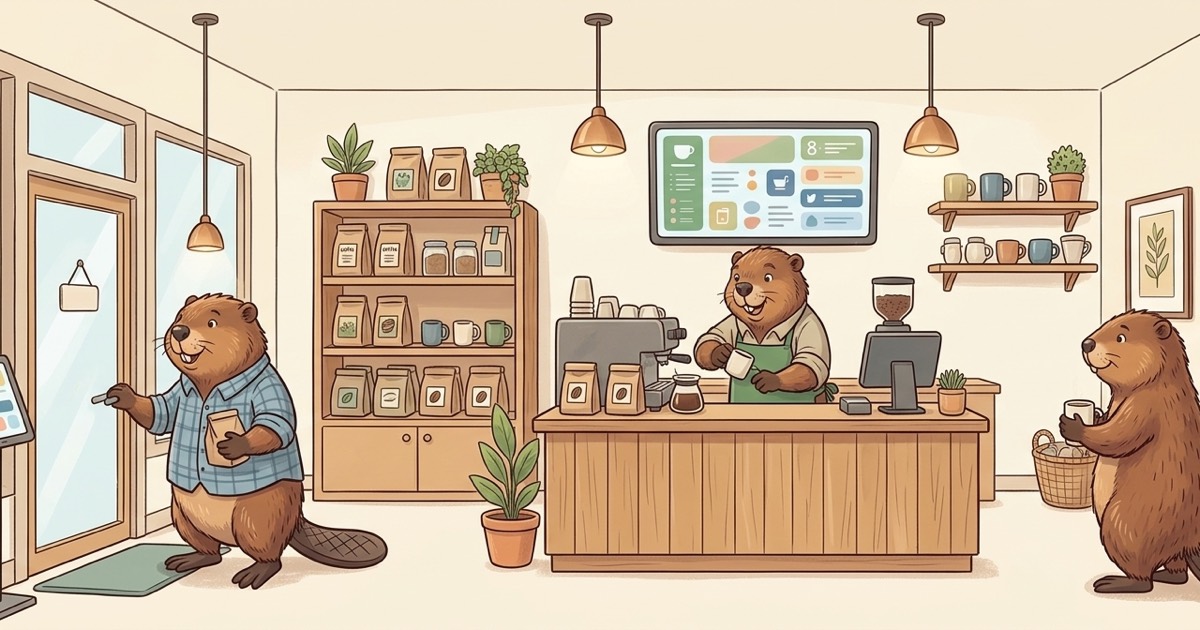
Every business space communicates something the moment a customer walks in, whether you planned it or not. The difference between a space that sells and one that just sits there is whether you’re directing the conversation.
Your space is never silent
Walk into any business and you start reading it before anyone says a word. The handwritten sign taped to the counter. The poster from a promotion that ended two months ago. The TV in the corner looping a screensaver. The empty wall by the register. All of it is telling your customer something about what you sell, what’s worth their attention, and how much you sweat the details.
That’s the part most owners miss. The question was never “should my space communicate?” It already does. The real question is whether it’s saying what you actually want it to say, in the right spot, at the right moment.
Most spaces are saying very little. By accident.
What “a TV with slides” actually costs you
The usual fix is to mount a screen and loop a slideshow. It feels like progress. But a single screen running the same playlist on repeat treats every customer the same: the one walking in for the first time, the one waiting in line, the regular who already knows what they want. One message, everywhere, all day. It’s a poster that happens to glow.
The screens that earn their keep do something different: they show the right thing in the right place. And the payoff is real and well documented.
- In a Nielsen in-store study, 4 out of 5 brands saw up to a 33% increase in additional sales from digital point-of-sale screens.
- Industry data shows digital displays draw up to 400% more views than static signs.
- In a FedEx Office retail survey, about 8 in 10 shoppers said they’d walked into a store they’d never visited because a digital sign caught their attention.
- And where there’s a line, industry studies report digital signage can cut perceived wait time by up to 35%.
None of that comes from owning a screen. It comes from the screen saying the right thing to the right person.
Five questions your space is already answering
Here’s a more useful way to look at your space. Every customer moves through it asking a short series of questions, and every part of your space is either answering them or leaving them hanging. We group those into five zones.
- Welcome: “Do you have what I need?” The entrance and window. Its job is to pull people in and point them the right way.
- Discovery: “What are my options?” The aisles and browsing areas, where people are deciding.
- Spotlight: “What’s special right now?” The counter, the endcap, the feature wall, where you push the one thing you want to move today.
- Engage: “Tell me more while I wait.” The line, the lobby, the chair: captured attention most spaces waste.
- Internal: “What should we focus on?” The back of house, where your team stays aligned.
You don’t need all five. A coffee shop lives in Welcome, Spotlight, and Engage. A studio leans on Welcome and Engage. The point isn’t to fill every wall with screens. It’s to notice which questions your space leaves unanswered, and answer them on purpose.
That’s the whole idea behind the 5-Zone Framework, and it’s why “what should I put on a screen?” is the wrong first question. The right one is “what is each part of my space supposed to do?”
What this looks like in practice
Take a coffee shop. The window (Welcome) shows you’re open and what’s fresh today. The screen above the counter (Spotlight) features one seasonal drink, not the whole menu. The screen by the pickup area (Engage) runs the loyalty program and a local event while people wait. Three zones, three jobs. And digital menu boards alone can lift unplanned purchases by up to 80%, because the right prompt at the right moment is how impulse works.
Or a boutique. The window stops foot traffic with new arrivals. A counter screen spotlights the piece you’re trying to move this week. The area by the fitting rooms answers “what goes with this?” None of it is more screens for the sake of screens. It’s each zone doing one job well.
The right thing, in the right place, at the right moment
Once you think in zones, the content gets obvious. Your window promotes; it doesn’t list your hours. Your line entertains or upsells; it doesn’t loop your logo. Your counter spotlights one thing; it doesn’t show twelve. And when the special changes, you change it. From your phone, in the moment, not the next time you remember to swap a poster.
This is what we mean when we say spaces should engage. Not louder. Not more screens. A space that responds to the person in it and the moment they’re in.
The category is growing for a reason. It’s roughly a $31 billion market today, on its way to about $46 billion by 2030. But the growth isn’t really about screens getting cheaper. It’s about owners realizing their space has been talking all along, and deciding to give it something worth saying.
Your space is already talking. The only question is whether you’re writing the script.