
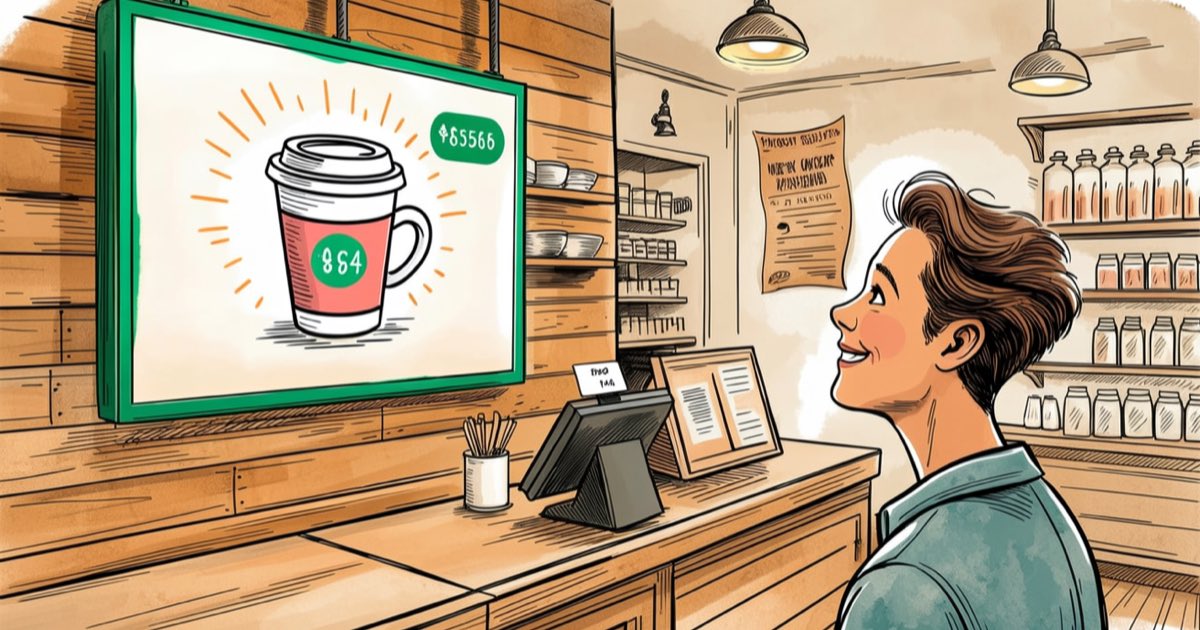
A sign is a cost. The good ones earn it back. Most never get the chance.
Walk into almost any small business and you’ll find a sign that’s been saying the same thing for longer than the owner can tell you. A printed poster in the window. A chalkboard nobody’s wiped since spring. Maybe a TV in the corner looping the same three slides. It’s on. It looks fine. And it’s doing almost nothing for the business.
That’s the real question behind “is digital signage worth it for a small business.” It isn’t about the screen. It’s about whether the screen does a job.
On is not the same as working
You put a TV on the wall, load a slide, and cross it off the list. The screen’s lit. You feel modern. But a screen looping one slide is just a poster that costs more to run. It greets nobody and sells nothing.
A sign that works is a different animal. It says the right thing to the right person at the right moment. It points a first-timer toward the thing they came for. It pushes the special while the special’s still hot. It fills the wait at the counter with a reason to come back. That’s the gap between a screen that’s on and a screen that’s working, and it’s the whole ballgame.
A working screen sells. That part isn’t a guess.
When a screen actually does its job, the numbers show up. In a Nielsen in-store study, four out of five brands saw sales climb by as much as 33 percent from digital screens at the point of sale. Digital menu boards have been shown to lift unplanned purchases by up to 80 percent: the extra coffee, the add-on, the thing the customer didn’t walk in planning to buy. And digital displays pull as much as 400 percent more views than a static sign, because motion catches an eye that a printed poster never will.
Those are industry figures, not ours, and they all point the same way. A screen that engages customers moves them. A screen that just sits there doesn’t.
The businesses winning right now aren’t spending more. They’re engaging.
2026 is a tight year, and every owner is watching the till. So look at who’s actually winning foot traffic. The location-analytics firm Placer.ai credits Target’s 2026 turnaround to longer, more engaged in-store visits, not lower prices. In restaurants, Placer found that value isn’t about being the cheapest anymore. It’s about the whole experience, and the chains growing fastest are the ones giving people a reason to show up. Chipotle’s biggest traffic weeks lined up with its loyalty launches and limited-time menu drops, the moments it gave customers something to engage with.
When money’s tight, the first thing an owner cuts is “marketing,” because it feels optional. But a screen that engages customers isn’t decoration you can cut. It’s closer to a salesperson who never takes a break. One earns its keep. The other is just a bill. The difference is entirely in whether the thing does a job.
What “working” actually looks like
Think about your space as a set of moments, not one flat message.
At the door, a customer’s asking “do you have what I need.” That’s where a screen directs them. At the counter, they’re deciding, and that’s where you show the special or the pairing. In the wait, they’re bored, and that’s where you build the relationship for next time. That’s the thinking behind organizing a screen by zone: a different job in each part of the space. One printed sign can’t be all of those things at once. It picks one and freezes.
A working screen changes with the moment. Breakfast menu in the morning, dinner by five. The umbrellas up front when it rains. The overstock moved when you need it gone. A poster can’t react to any of that. By the time you’ve printed a new one, the moment’s passed.
You don’t need a bigger budget. You need the screen to earn its keep.
If you’ve already got a screen and it isn’t pulling its weight, the fix isn’t spending more. It’s making the thing you own actually work: the right message, in the right spot, changing as the day changes. If you don’t have one yet, that’s the bar to hold it to before you spend a dollar. Not “does it look modern.” Does it sell.
Your space is already talking to every person who walks in. The only question is whether it’s saying something worth hearing.
BrandCast helps small businesses turn their screens into something that works the room, organized around the moments that matter in your space. We are opening early access to a small group of owners now. See how it works.